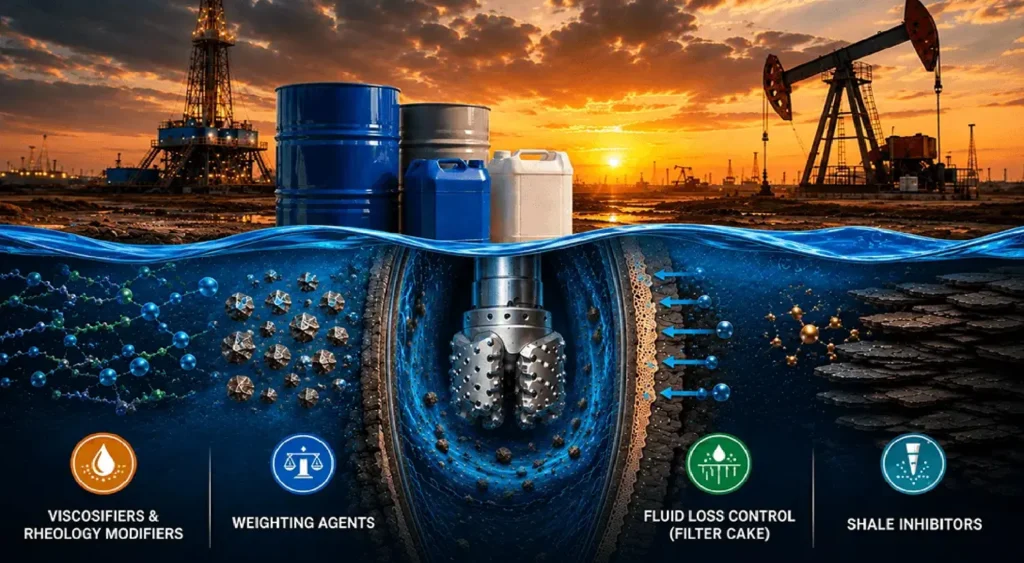
Drilling fluid, commonly called drilling mud, is an essential part of modern oil and gas drilling operations. By controlling properties such as viscosity, density and fluid loss, drilling fluids help support safe and efficient drilling. Chemical drilling additives are used to adjust these properties and maintain fluid performance under changing downhole conditions.
The right combination of drilling fluid additives can help cool and lubricate the drill bit, transport drilled cuttings to the surface, maintain wellbore stability and control formation pressure. Without effective control of these fluid properties, drilling performance and well integrity can be affected.
Types of Drilling Fluids
Before selecting Drilling Additives, it is important to understand the main drilling fluid systems used in oil and gas wells.
- Water-Based Fluids (WBM & WBPM): Generally among the most widely used and economical systems. They use water as the continuous phase, often with bentonite and polymers such as polyanionic cellulose (PAC) to support rheology and shale control.
- Oil-Based Fluids (OBM): Use diesel or mineral oil as the continuous phase and can provide high temperature stability and strong lubricity. Low-toxicity oil-based muds and invert emulsion systems are used where their performance characteristics are required.
- Synthetic-Based Fluids (SBM): Use synthetic base fluids for demanding applications, including deeper and higher-temperature wells where enhanced drilling performance may be required.
Rheology Modifiers and Viscosifiers
Viscosifiers are drilling additives used to increase fluid viscosity, while rheology modifiers help control how the drilling fluid flows under different shear conditions. Managing these properties is essential for maintaining an adequate viscosity and yield point throughout the drilling process.
Their main functions include:
- Cuttings transport: Appropriate rheological properties help carry drilled cuttings through the annulus and toward the surface.
- Solids suspension: Adequate viscosity and yield point help keep drilled solids suspended when circulation slows or stops, reducing the risk of settling at the bottom of the well.
Weighting Agents for Pressure Control
Mud density, commonly referred to as mud weight or specific gravity, is critical for maintaining hydrostatic pressure and controlling formation fluids. Weighting agents such as barite and hematite are high-density mineral solids added to increase drilling fluid density.
Key functions include:
- Hydrostatic balance: Provides the pressure needed to help prevent formation fluids from entering the wellbore.
- Wellbore stability: Supports the pressure balance required to help maintain the integrity of the formation around the wellbore.
Fluid Loss Control Additives
Fluid loss control is a major function of drilling additives. Filtration can occur when drilling fluid moves into porous and permeable formations because of pressure differences between the wellbore and the formation. Additives such as polyanionic cellulose (PAC), starch and carboxymethylcellulose (CMC) help reduce filtrate loss by forming a thin, low-permeability filter cake on the wellbore wall.
Effective fluid loss control helps with:
- Reservoir protection: Reduces the potential for formation damage caused by unwanted fluid invasion.
- Wellbore stability: Helps maintain a consistent, low-permeability filter cake along the wellbore wall.
- Performance monitoring: Engineers can evaluate filtrate volume and filter cake thickness using established API filtration test methods.
Shale Inhibitors
Reactive shale formations can hydrate, swell or slough when exposed to water. Shale inhibitors are drilling fluid additives used to reduce the interaction between formation water and reactive shale. Common examples include potassium chloride (KCl), glycols and polyamine-based inhibitors.
Their functions include:
- Limiting water interaction with reactive shale clays.
- Reducing drilling problems such as tight hole conditions, bit-balling and shale sloughing.
Lubricants and Friction Reducers
In directional and horizontal wells, torque and drag can become significant operational challenges. Lubricants and friction reducers are used to improve drilling performance by reducing friction between the drill string, drilling fluid and wellbore environment.
Potential benefits include:
- Reducing wear and friction-related equipment stress.
- Reducing the risk of differential sticking under suitable drilling conditions.
- Supporting drilling efficiency through lower torque and drag and improved penetration performance.
Drilling Fluid Additive Performance and Monitoring
Correct additive selection and dosage require careful monitoring, testing and engineering calculations. Performance should be evaluated as drilling conditions and fluid properties change.
- Mud density calculations to determine the required fluid weight.
- Rheology testing, using instruments such as a Marsh funnel viscometer where appropriate, to evaluate fluid flow characteristics.
- Weighting material calculations to determine the amount of barite or another weighting agent required to reach a target mud density.
- Mud pump output calculations to support effective circulation and cuttings transport.
Drilling Additives at a Glance
| Additive Type | Main Function | Examples |
| Rheology Modifiers / Viscosifiers | Control viscosity, yield point and flow behaviour | Bentonite, PAC and other rheology-modifying polymers |
| Weighting Agents | Increase mud density and support pressure control | Barite, hematite |
| Fluid Loss Control Additives | Reduce filtrate loss and support filter-cake formation | PAC, CMC, starch |
| Shale Inhibitors | Reduce shale hydration, swelling and sloughing | KCl, glycols, polyamine-based inhibitors |
| Lubricants / Friction Reducers | Reduce torque and drag and improve lubricity | Specialty drilling lubricants |
Frequently Asked Questions About Drilling Additives:
What are drilling additives?
Drilling additives are chemicals added to drilling fluids to control properties such as viscosity, density, fluid loss, lubricity and shale stability.
What are the main types of drilling fluid additives?
Common categories include viscosifiers and rheology modifiers, weighting agents, fluid loss control additives, shale inhibitors, lubricants and friction reducers.
What is the purpose of fluid loss control additives?
They help reduce filtrate loss from the drilling fluid into permeable formations and support the formation of a low-permeability filter cake.
Why are shale inhibitors used in drilling fluids?
They are used to reduce the interaction of water with reactive shale and help limit swelling, sloughing and related drilling problems.
How are drilling additive performance and dosage monitored?
Performance can be evaluated through drilling-fluid tests and engineering calculations covering density, rheology, filtration, weighting material requirements and pump output.
Conclusion
Drilling Additives play a central role in maintaining drilling fluid performance and supporting safe, efficient well construction. From rheology modifiers and viscosifiers to fluid loss control additives, shale inhibitors, weighting agents and lubricants, each additive category addresses a specific drilling challenge. Selecting the appropriate products, dosage and fluid system requires careful testing and engineering evaluation to help operators maintain wellbore stability, control fluid properties and reduce non-productive time (NPT).