1. Introduction
Concrete calls for a combination of strength, workability, durability, and ease of placement. While increasing the amount of water may provide better workability, it is also true that too much mixing water can detrimentally impact the final properties of the hardened concrete.
This is how chemical admixtures come into play.
Superplasticizers are some of the most used admixtures for improving the performance of concrete without the excessive addition of water. They enable concrete producers and contractors to gain a workable mix without having to reduce the water-cement ratio.
Also known as high-range water reducers, superplasticizers enable a significant rise in the fluidity of the concrete while resulting in a mixture that is easily transported, pumped, placed, and finished. Correctly selected and dosed, superplasticizers can help achieve better concrete strength, durability, and overall performance.
2. What Are Superplasticizers?
Superplasticizers are chemical admixtures that are used in concrete to provide more fluidity and workability while reducing the amount of mixing water required. They are essentially more potent equivalents of plasticizers for concrete, where extremely high fluidity rates are required to meet the demands of special concrete mixtures.
The basic mechanism in action is relatively simple. The cement particles in a concrete mixture naturally stick together as they do not repel each other. This creates cement clusters that reduce the fluidity and make the mixture less workable. Through the process of cement dispersion, superplasticizers allow the cement particles to break away from each other, enabling the water in the mix to work more efficiently throughout the mixture.
As such, concrete can be made more fluid without the addition of more water.
This is especially important when a project calls for greater fluidity or higher pumping capacity without an increase in water-cement ratio. According to the supplied technical material, high-range water reducers can increase the fluidity and plasticity of the mix while reducing the water-cement ratio to decrease porosity and crack formation and improve the durability of the hardened concrete.
3. How Superplasticizers Improve Concrete Workability
Concrete workability refers to the ease of mixing, transporting, placing, and compacting the concrete without the creation of undesirable constituents.
Poor workability can be an issue both on the construction site and through the concrete itself. Concrete placement becomes an issue, especially when structures have dense or complex reinforcement or require the use of very narrow forms. Simply adding more water is a solution that might seem tempting but can increase the water-cement ratio beyond desirable levels.
Superplasticizers allow another approach.
By making sure that cement particles break away from each other, superplasticizers enable better flow in the mixture without increasing the water content of the mix. They offer more flexibility in terms of workability, which is why they can be used for concrete that has to be placed under specific conditions.
An improvement in workability can translate to better ease of placement, especially in relation to the reinforcement in the structure. The correct superplasticizer dosage allows the mix to be placed, even in difficult areas, with less effort, while improving the overall quality of the mixture.
It should also be noted that the effectiveness of the superplasticizer is tied to the cement, aggregates, design, environmental factors, and dosage. As such, any of these variables have the potential to affect the performance of the superplasticizer in a given mixture, and there is no single dosage that can be used in any concrete mixtures.
4. Superplasticizers and Water Reduction
One of the main advantages of superplasticizers is their ability to reduce the amount of water that must be present in a given mixture in order to achieve the desired workability.
The water-cement ratio plays an important role in concrete properties upon hardening. As such, a reduction in unnecessary water will reduce the formation of pores and lead to higher-density concrete.
This is, in fact, one of the main advantages of high-range water reducer admixtures. Instead of choosing between a workable mix and a lower water-cement ratio, the correct admixture can allow for both.
For instance, a concrete producer may have to choose a workable mixture that allows for pumping and placement with acceptable qualities upon hardening. Instead of simply adding more water, a superplasticizer allows the mix to be fluid without increasing the amount of water. In essence, the correct admixture usage allows for a better balance in between the required mixture and the overall outcome of the concrete when hardened.
5. The Role of Superplasticizers in Slump Retention
Workability is not only a property at the point when the concrete leaves the mixing machine. Its ability to maintain the desired degree of workability is what enables proper pumping, transportation, and placement without issues. This is especially true when it comes to concrete that has travel over a certain distance before being placed.
This is the importance of slump retention. Simply put, slump retention refers to the performance of a given concrete mix under time constraints. Concrete at the point of batching may present with an acceptable slump but begin to dry out during transportation time due to the characteristics of the mix.
The choice of a suitable superplasticizer is crucial in order to ensure that concrete slump is not lost too soon following mixing. It should further be noted that slump retention is an issue of the admixture as well as cement chemistry, temp, mixing, transportation, and the overall mix design.
As such, the performance of the admixture should be tested under conditions that can represent the environment and project.
6. Determining the Right Dosage
The correct dosage of superplasticizer is what ensures that the required properties are achieved. Too little and the required range may not be achieved; too much and a whole new set of issues emerge.
The supplied technical material suggests that dosage varies depending on the requirements of a given project. It does list a standard range that applies to most concrete batches of approximately 1.5% to 2%, where lower ranges were suggested for very large-scale batches with specific strength requirements.
These ranges should not be seen as an absolute truth as the dosage is affected by material properties and project requirements.
Trial mixes should be performed to ensure that the desired workability and water reduction are achieved without compromising other essential concrete properties and characteristics.
By ensuring that the correct dosage is applied, workability and water reduction can be consistent throughout the mixing process, transportation, pouring, and curing.
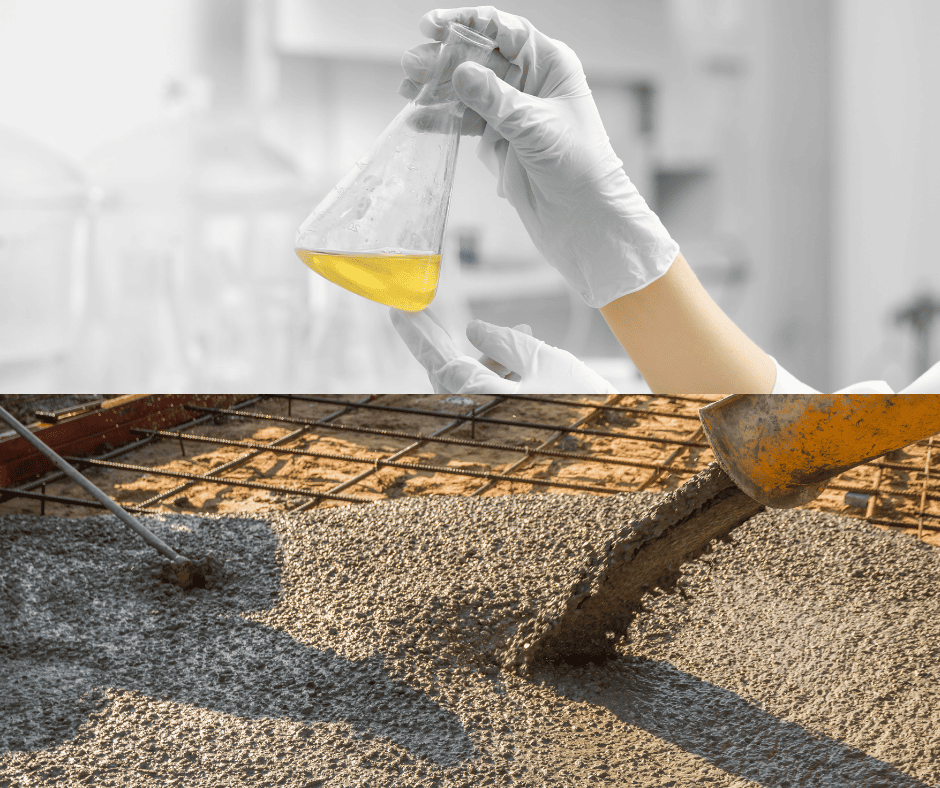
7. Risks of Overusing Superplasticizers
More admixture does not equal better concrete.
Overdosing high-range water reducers can end up creating more issues for the concrete, including excessive fluidity, segregation, water seepage, pumping and placement issues, and difficulties when hardening.
According to the supplied material, overdosage can lead to delayed setting, potential loss of concrete strength, excessive slump, and increased brittleness.
Excessive fluidity is the most obvious risk in relation to superplasticizers. If the mixture experiences excessive levels of fluidity, it can be harder to place and finish, as the properties of the mix can fluctuate.
The other risk that overdosage poses is related to the setting time. Applying too much admixture, especially when combined with a retarding admixture, can delay the setting process and compromise its early strength.
It should be reiterated that the best form of risk-mitigation when working with superplasticizer admixtures is ensuring that correct dosages are applied. When an overdose occurs, adjustments can be made to accommodate. These can range from adjusting the water consistency, cement and/or slurry consistency, or incorporating viscosity-modifying admixtures to restore stability in the mix.
8. Applications of Superplasticizers in Modern Construction
Superplasticizers find their applications in a wide variety of concrete mixtures where the characteristics of the mixture need to be controlled and adjusted. They are especially useful in relation to very high strengths, pumped concrete, heavily reinforced structures, precast concrete, and structures that require high flowability without an increase in water content.
They are further applied in situations when the placement conditions create additional difficulties. Concrete may have to be conveyed over pumping systems, fill dense reinforcements, or simply stay workable for longer before placement.
In all cases, it is worth noting that simply adding a superplasticizer is not a solution, but rather an enabler. The objective should rather be to achieve the desired characteristics within a mixture, including workability, strength, durability, pumping and flowability characteristics, placement time, and slump retention.
9. Conclusion
Superplasticizers have enabled the production of concrete that maintains high levels of workability while limiting water content. As high-range water reducers, they can allow a significant increase in fluidity, eliminate the need for extra mixing, and ensure that high durability and high-performance concrete can be placed without issues.
Their use spans across a wide range of requirements, from those of very high strength through to pumping and placement challenges or issues with slump retention. However, they have to be approached with care, as excess amounts can create issues with fluidity, segregation, and setting time.
As such, the correct application of plasticizers for concrete relies on understanding the material as a whole, including its components, and test-mixing in order to achieve the desired outcome. In essence, the aim of higher workability and reduced water content is not fulfilled when extra amounts are used but when the correct superplasticizer is applied.