1. Introduction: The Shift Toward Green Manufacturing
Industries are increasingly looking to improve their overall efficiency while simultaneously minimizing environmental impact. Historically, industrial manufacturing has relied greatly on fossil-based feedstocks such as coal, oil, and natural gas. While these traditional materials have supported industrial expansion, their finite nature has led to increased interest in finding alternative resources for manufacturing.
This has seen growing attention paid to Sustainable Industrial Raw Materials capable of supporting industrial production that do not rely as greatly on non-renewable resources.
Sources such as biomass, agricultural crops, vegetable oils, natural fibers, and bio-based materials can be leveraged to yield a variety of products. In particular, renewable resources are of interest to a number of fields, including plastics, chemicals, packaging, coatings, cosmetics, pharmaceuticals, and manufacturing.
However, green manufacturing is not simply about choosing different materials. It is about taking a broader view of a material’s supply chain, including origin, technical performance, regulatory compliance, availability, and technical and economic suitability for long-term industrial use.
2. What Are Sustainable Industrial Raw Materials?
Sustainable Industrial Raw Materials are materials that are sourced and produced with greater emphasis on their overall availability, impact, and utility for long-term industrial use.
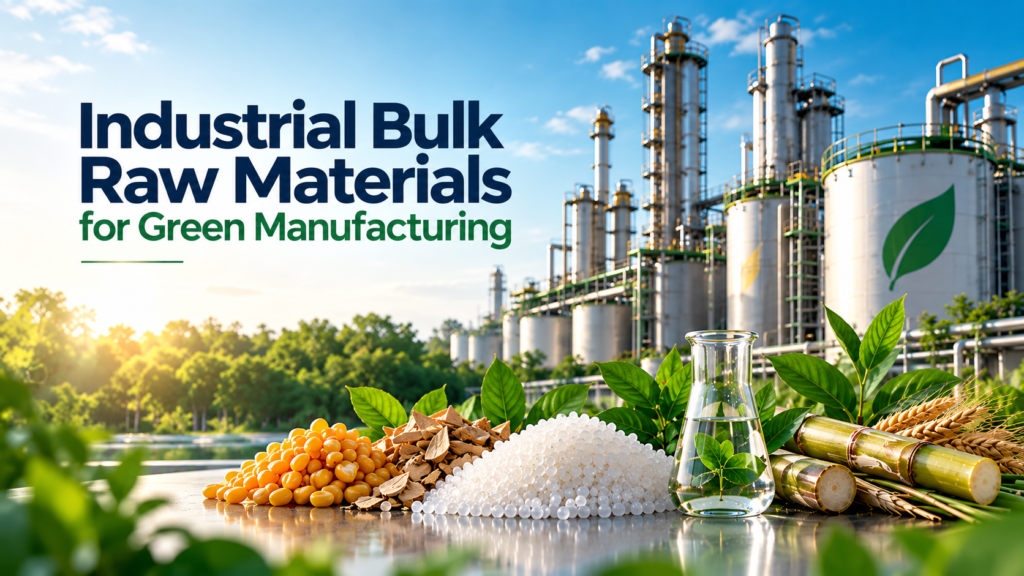
A primary category of these materials is comprised of renewable raw materials that are sourced from non-fossil resources. Unlike oil, coal, or natural gas, renewable feedstocks can have a variety of origins, including plants and biomass. Examples of renewable feedstocks include:
- Agricultural crops (e.g., corn, sugar cane, wheat, potatoes)
- Vegetable oils and fats
- Wood and biomass
- Natural fibers (e.g., cotton, linen, hemp)
- Seaweed and other biological resources
- Chemical feedstocks derived from biomass
Renewable resources can be used across a variety of industries, including plastics and packaging, cosmetics, food, textiles, energy, and other manufacturing.
It is worth noting that the term “bio-based” does not inherently imply “biodegradable.” The biodegradability potential of a material is dictated by its chemical structure as well as its additives and processing conditions.
3. Why Industries Are Moving Toward Renewable Raw Materials
A key driver for the shift toward renewable materials is the need to reduce dependence on non-renewable fossil resources.
Renewable feedstocks can help manufacturers to achieve this objective in a variety of ways.
Reduction in Fossil Resource Use
Using renewable feedstocks can reduce manufacturers’ dependence on non-renewable resources and diversify the sources of industrial feedstocks.
Possible Reduction in CO₂ Emissions
Replacing non-renewable feedstocks with renewable alternatives can help to reduce greenhouse gas emissions associated with industrial manufacturing.
Support for Circular Economy Approaches
Using renewable feedstocks can support the design of systems that are more focused on closed-loop material cycles and reduced waste.
A New Era of Material Innovation
Renewable feedstocks are also being leveraged to develop new materials via green chemistry and biotechnology. For example, natural feedstocks are being used to engineer a variety of bioplastics.
This shows that sustainability and material innovation are often complementary, rather than mutually exclusive, objectives.

4. Industrial Bulk Raw Materials and Green Manufacturing
When it comes to large-scale manufacturing, sustainability is not just a choice—it is an imperative.
While it is one thing to develop an environmentally preferable compound in a laboratory, it is another to source this compound in the volumes, specifications, and delivery schedules required by an industrial plant.
This is where industrial bulk raw materials come in.
Manufacturers must ensure that a sustainable or renewable material they select will actually be viable at an industrial level. This means considering a number of factors, including:
- Specification requirements
- Overall availability in bulk
- Logistics and storage
- Batch-to-batch consistency
- Technical compatibility
- Regulatory documentation
- Cost of ownership
- Continuous supply
For example, renewable feedstocks such as vegetable oils, agricultural biomass, starch, sugar, and other natural resources can be used as input materials for a variety of industrial applications. These feedstocks can then be refined into bio-based plastics and other chemical materials. new article The aim, therefore, is not to find a “green” alternative material per se but to find the most viable option in terms of sustainability, industrial performance, and supply reliability.
5. Bio-Based Materials and Bio-Based Solvents
The development of bio-based chemistry is one of the most exciting aspects of sustainable manufacturing.
Bio-based materials utilize renewable resources as their feedstocks. In the field of plastics, for example, bio-based sources such as PLA, PHA, and other polymers are being leveraged to yield bioplastics.
A similar approach is being taken in the case of bio-based solvents.
Petroleum feedstocks are the primary source of solvents. However, renewable resources such as bio-based chemicals can be leveraged to engineer bio-based solvents. Depending on their chemistry and potential industrial use, bio-based solvents can find application in a variety of fields, including coatings, cleaning, pharmaceuticals, cosmetics, and other manufacturing.
However, manufacturers must take a broader view when it comes to selecting a bio-based solvent. In addition to the origin of the solvent and its impact, they must take various factors into account, including:
- Does the solvent provide the required level of purity?
- Is the solvent compatible with the formulation?
- Is the solvent’s solvency appropriate?
- What is the solvent’s overall performance characteristics?
- Is there sufficient supply at the required industrial scale?
- Is the solvent compliant with all relevant regulations?
This further underscores the point that a sustainable raw material must first and foremost be a technically suitable raw material.
6. The Role of Eco-Friendly Chemical Supply Chains
When it comes to industrial production, the way in which a material reaches a manufacturer can be just as important as the material itself.
An eco-friendly approach to chemical supply prioritizes responsible sourcing, cost-effective transportation and logistics, traceability, appropriate storage, and reliable distribution.
For industrial buyers, supply assurance is of primary importance. Switching to a sustainable raw material that cannot be delivered continuously can put a manufacturer at risk.
Strong chemical supply partners, therefore, can support manufacturers in finding alternative sources, identifying suitable materials, and coordinating their procurement and logistics to ensure supply continuity. This is particularly important for manufacturers that are transitioning from conventional raw materials to more sustainable options.
The aim should be to achieve a balance between: Sustainability + Quality + Availability + Cost + Performance
7. REACH Compliant Materials and Responsible Sourcing
When it comes to eco-friendly manufacturing, environmental impact is not the only consideration.
Compliance with relevant regulatory frameworks is also essential.
For companies that operate in or serve the European market, REACH compliant materials are a major consideration. REACH (Registration, Evaluation, Authorisation and Restriction of Chemicals) is the EU regulation that governs the use of chemical substances within the region. For industrial buyers, therefore, regulatory compliance can become a critical consideration during the raw material qualification process.
When selecting a sustainable or renewable chemical feedstock, manufacturers must ensure that it satisfies a range of regulatory requirements, including:
- Applicable regulatory status
- Safety Data Sheets (SDS)
- Technical Data Sheets (TDS)
- Substance registration requirements
- Restrictions or authorization requirements
- Product traceability
- Supplier documentation
Sustainability and regulatory compliance must work together, rather than being considered as separate purchase criteria.

8. Key Considerations When Selecting Sustainable Raw Materials
Before selecting a sustainable alternative to an established raw material, manufacturers must take a number of questions into account.
1. Technical Performance
Does the proposed alternative provide the necessary performance?
2. Consistency
Can the supplier provide a reliable and consistent supply?
3. Availability
Can the material be obtained consistently at the required scale?
4. Regulatory Compliance
Does the material comply with relevant regulations?
5. Environmental Profile
What resource does the material originate from, and what environmental benefits can it realistically deliver?
6. Cost
Does the material provide an acceptable cost across procurement, logistics, processing, and other relevant factors?
7. Compatibility
Will it be compatible with the formulation, equipment, and overall process?
These questions are designed to help manufacturers avoid the trap of selecting a raw material based solely on a “sustainability” label without taking its ability to deliver consistent performance at scale into account.
9. The Future of Sustainable Industrial Raw Materials
The shift toward sustainable manufacturing is likely to accelerate as industries seek to identify alternatives to non-renewable fossil resources.
Renewable feedstocks, biomass, bio-based polymers, and bio-based solvents are enabling manufacturers to innovate and develop new products. At the same time, green chemistry approaches are also enabling the development of new materials that combine performance with improved environmental characteristics.
As manufacturers move forward, the focus will no longer be on finding a “green” material but rather on developing diversified raw-material strategies that combine renewable and conventional materials where appropriate. The focus will move away from the question:
“Is this material sustainable?” toward such considerations as:
“How sustainable is it?”
“Can it perform at industrial scale?” “Can we source it consistently?”
“Does it meet our regulatory and customer requirements?”
This broader approach can help manufacturers to integrate sustainability into their procurement and production strategies over the long term.
10. Conclusion
The transition toward green manufacturing is transforming the way industrial companies approach raw material sourcing.
Sustainable Industrial Raw Materials can help manufacturers to reduce their reliance on non-renewable resources, support circular economy strategies, and leverage innovative manufacturing technologies. Renewable feedstocks such as biomass, agricultural crops, vegetable oils, and natural fibers are being explored and adopted by a range of industries. new article However, sustainability alone is not enough.
For industrial manufacturers, the right raw material must also deliver consistent quality, performance, regulatory compliance, supply security, and value. From the perspective of bio-based solvents and renewable feedstocks to REACH compliant materials and responsible eco-friendly chemical supply strategies, the future of manufacturing will be characterized by an embrace