
Introduction: Why Cold Weather Requires Faster Concrete
Cold weather means slow setting of concrete, slow gain of strength, and delays in construction. Yet concrete can be placed successfully during cold weather.
When temperatures drop near 5°C the rate of hydration decreases significantly, so that set time and initial strength gain increase dramatically.
If concrete is allowed to freeze prior to achieving sufficient early strength, it may be permanently damaged.
This is where concrete accelerators can be helpful.
Accelerating admixtures are used to decrease set time and increase early strength gain of concrete.
According to the American Concrete Institute accelerating admixtures are one of the categories of chemical admixtures used to accelerate setting and gain of early strength.
Accelerating admixtures however are only a part of the solution.
What are Concrete Accelerators?
Concrete Accelerators are used to quicken setting of concrete and to increase the rate of increase of strength at early ages.
Accelerators are suitable for use in situations where:
- rapid setting of concrete is required;
- there is a need for earlier finish and removal of forms;
- there is a need for higher early strength of concrete;
- construction or opening to traffic needs to occur more rapidly;
- rapid strengthening of concrete is beneficial or required;
Accelerators are considered as type C (accelerating) or type E (water reducing and accelerating admixture) according to ASTM C494.
It is important to understand that concrete requires proper curing; it is not enough to just make it “dry faster”.
Cold Weather & Accelerated Concrete Setting Times Low temperatures reduce the rate of cement hydration.
This reduces the rate of gain of strength and may necessitate extra curing measures and protection from freezing to allow concrete to reach design strength.
The low rate of early strength gain may delay the removal of forms and other construction operations.
Furthermore, fresh concrete has a susceptibility to freezing, and the earlier it is exposed to freezing temperatures, the greater the risk of damage.
In addition, low temperatures prolong construction time, and reduce the rate of progress of work.
Accelerating admixtures help to increase early strength and reduce set time. However they cannot prevent concrete from freezing.
Proper thermal protection of concrete from freezing should be given special attention, particularly when temperatures are likely to drop below freezing.
In addition, the use of concrete accelerators should be accompanied by adequate forms of insulation and heating, and temperature monitoring, if concrete is exposed to sub-zero temperatures.
Set accelerators vs rapid hardening chemicals
The terms set accelerators and rapid hardening chemicals are used interchangeably, but in reality each product has a specific end objective.
Set accelerators mainly shorten set time of concrete.
Set accelerators may benefit situations where rapid finishing is required or where delays in construction due to low temperatures become an issue.
Rapid hardening refers to increasing the rate of increase of early strength of concrete.
Rapid hardening can benefit situations where there is a need for earlier formwork removal or a fast track construction schedule.
In short, either objective may be required depending on the nature of the project.
Calcium chloride additives: pros and cons
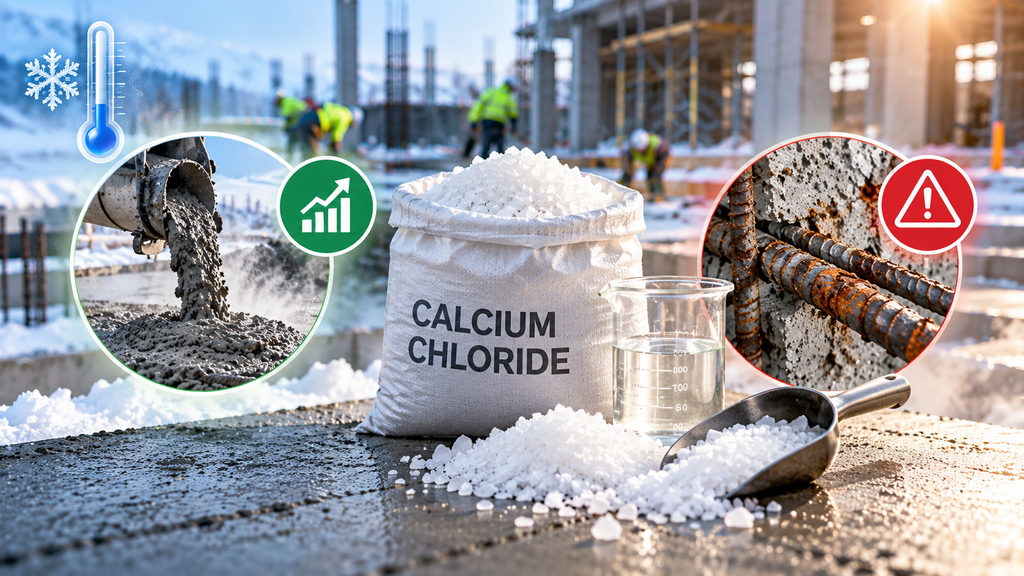
Calcium chloride is a traditional additive used to accelerate setting and gain of early strength of concrete.
Calcium chloride is very effective and economical.
NRMCA identifies calcium chloride as a common accelerating admixture and notes that it is available in liquid and flake form.
However, chloride ions can contribute to corrosion of reinforcement.
It’s application depends on the concrete being constructed. NMRCA reports that calcium chloride can be used without restriction in non-reinforced concrete, whereas when reinforcement is present, the permissible limits of chloride should be taken into account.
ACI points out that when considering use of calcium chloride for accelerating setting of concrete, the effect of calcium chloride on reinforcement should be kept in mind.
Accelerated early strength is not beneficial if application of calcium chloride accelerates long term degradation of the structure.
Calcium chloride is not always a viable option for concrete with reinforcement.
Non-chloride accelerators for reinforced concrete
Non-chloride accelerators are an attractive alternative in situations where use of chloride containing materials is restricted.
Non-chloride accelerators have active ingredients other than calcium chloride. Typical non-chloride accelerator types are nitrate and nitrite type materials.
They can be used successfully in many types of concrete.
They are particularly relevant in reinforced concrete, precast concrete, structural concrete, and concrete where chloride restriction applies.
The selection should be based on the complete concrete formulation, project requirements, set time criteria, temperature conditions, and early strength requirements.
Choosing the right accelerator: what to consider
The selection of concrete accelerator is not always as simple as the lowest temperature forecast.
Before selecting a product consider the following:
- Project temperature: how low will temperatures be?;
- Required strength: how soon will the concrete need to reach the strength required for form removal or loading?;
- Reinforcement: is the concrete reinforced or prestressed? If reinforcement is present, the use of chloride based accelerators may be restricted or inappropriate, depending on applicable specifications;
- Construction schedule: does the project require rapid construction?;
- Concrete mix design: the accelerator needs to be suitable for the cementitious materials, water-cementitious ratio, other admixtures, as well as the project mix design;
- Curing and protection: what forms of insulation, blankets, heating and monitoring will be used?;
ACI specifically identifies type of admixture (including dosage) as well as insulation and curing conditions as parameters to consider when accelerating concrete in cold weather.
Best practices for cold weather concrete
Accelerating admixtures are only part of the strategy for winter concreting. Before placement:
- Monitor the weather forecast and overnight temperatures;
- Prepare insulation, curing blankets or heating systems prior to placement;
- Prevent aggregates, mixing water, equipment from freezing;
- Avoid placing concrete on frozen subgrade;
- Ensure that selected accelerator is suitable for complete design mix;
- Confirm the target early strength; During placement and curing:
- Apply protection immediately following finishing;
- Monitor concrete temperature;
- Provide adequate insulation when there is a potential for freezing conditions;
- Control rate of temperature change;
- Avoid drying of the surface especially in cold windy conditions; After placement:
- Continue to maintain protection until sufficient early strength is attained;
- Avoid premature removal of insulation;
- Continue to monitor temperatures in extreme conditions;
- Confirm strength development prior to removing forms or applying significant loading;
The above approach reflects an important point about cold weather concreting: accelerating admixtures are only part of the picture.
Conclusion
Cold weather doesn’t have to bring construction to a standstill, but it does require additional consideration regarding setting time, early strength development, and protection.
Concrete accelerators can help to reduce setting times and increase early strength development and are a good option for cold weather concrete or rapid repairs.
Set accelerators can help to reduce set time, while rapid hardening products may be required in situations where rate of increase of early strength is important.
However in applications with reinforcement, long term durability needs to be given special consideration. In situations where chloride restriction applies, non-chloride accelerating admixtures are an appropriate alternative.
Ultimately, the best approach is to ensure proper selection of admixture, dosage, concrete mix, curing and thermal protection, to ensure that cold weather delays are avoided while strength, durability and long term performance of concrete are not compromised.